


Page 49 - AFMAN 15-111, 12 MAR 2019
P. 49
AFMAN15-111  12 MARCH 2019                                                                  49


                       10.3.6.2.  Sandstorms are encoded as SS, dust storms as DS. Report a moderate SS/DS
                       when visibility is reduced to less than 5/8 statute mile (1000 m) and greater than or equal
                       to 5/16 statute mile (0500 m) due to BLSA/BLDU. Report a +SS/+DS if visibility is less
                       than 5/16 statute mile (0500 m) due to BLSA/BLDU.

                       10.3.6.3.  Well-developed sand or dust whirls are encoded as PO.
               10.4.  Present Weather Capabilities of an FBWOS.   Using multiple sensors in conjunction,
               FBWOSs can determine and report the proximity, type and intensity of precipitation as well as
               obscurations and report up to three precipitation/obscuration groups.
                   10.4.1.  For liquid precipitation, the FBWOS determines intensity from particle size and fall
                   velocity through the sensor field. For snowfall, the minimum intensity is based on the reported
                   surface visibilities and may be reported higher than what is occurring due to other phenomena
                   that are reducing visibility.

                   10.4.2.  When equipped  with  a working lightning detection capability, an FBWOS  reports
                   thunderstorms as on station when cloud-to-ground lightning is detected within 5NM, in the
                   vicinity when detected between 5 and 10NM, and as a lighting distant remark in column 13
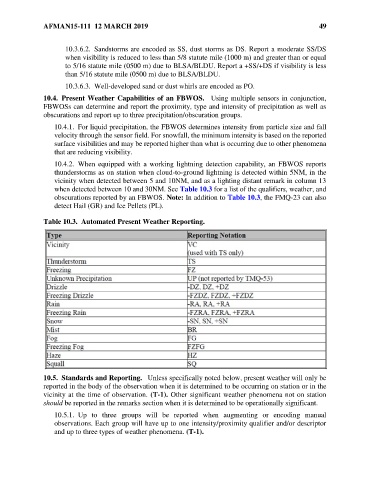
                   when detected between 10 and 30NM. See Table 10.3 for a list of the qualifiers, weather, and
                   obscurations reported by an FBWOS. Note: In addition to Table 10.3, the FMQ-23 can also
                   detect Hail (GR) and Ice Pellets (PL).

               Table 10.3.  Automated Present Weather Reporting.


               10.5.  Standards and Reporting.   Unless specifically noted below, present weather will only be
               reported in the body of the observation when it is determined to be occurring on station or in the
               vicinity at the time of observation. (T-1). Other significant weather phenomena not on station
               should be reported in the remarks section when it is determined to be operationally significant.

                   10.5.1.  Up  to  three  groups  will  be  reported  when  augmenting  or  encoding  manual
                   observations. Each group will have up to one intensity/proximity qualifier and/or descriptor
                   and up to three types of weather phenomena. (T-1).

