


Page 46 - ภาษาอังกฤษสำหรับสายวิทยาการอุตุนิยมวิทยา
P. 46
41


                       b.  The form of circulation that would occur in theory (as shown in figure 1) is greatly modified

               by many forces, one being the rotation of the earth.  In the northern hemisphere, this rotation causes

               air to In the southern hemisphere, air  flow to the right of its normal path. This action caused by the
               earth's  flows to the left of its normal path. We will only rotation is called the Coriolis force.  talk about

               the movement of the air in the northern hemisphere.

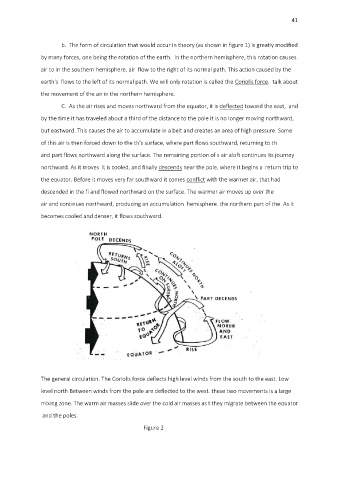
                       C.  As the air rises and moves northward from the equator, it is deflected toward the east,  and
               by the time it has traveled about a third of the distance to the pole it is no longer moving northward,

               but eastward. This causes the air to accumulate in a belt and creates an area of high pressure. Some

               of this air is then forced down to the th's surface, where part flows southward, returning to th
               and part flows northward along the surface. The remaining portion of s air aloft continues its journey

               northward. As it moves  it is cooled, and finally descends near the pole, where it begins a  return trip to

               the equator. Before it moves very far southward it comes conflict with the warmer air, that had
               descended in the fi and flowed northward on the surface. The warmer air moves up over the

               air and continues northward, producing an accumulation  hemisphere. the northern part of the  As it

               becomes cooled and denser, it flows southward.


               The general circulation. The Coriolis force deflects high level winds from the south to the east. Low

               level north Between winds from the pole are deflected to the west. these two movements is a large

               mixing zone. The warm air masses slide over the cold air masses as t they migrate between the equator
                and the poles.

                                                   Figure 2

