


Page 24 - ดาวเทียมอุตุนิยมวิทยา
P. 24
24


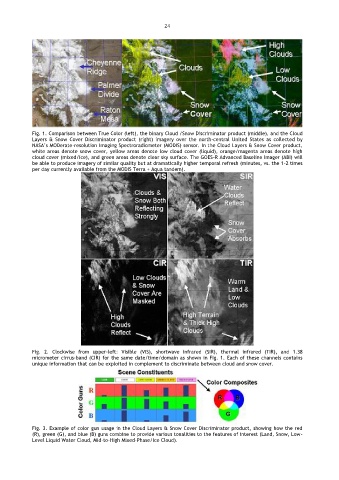
            Fig. 1. Comparison between True Color (left), the binary Cloud /Snow Discriminator product (middle), and the Cloud
            Layers  &  Snow  Cover  Discriminator  product  (right)  imagery  over  the  north-central  United  States  as  collected  by
            NASA’s MODerate-resolution Imaging Spectroradiometer (MODIS) sensor. In the Cloud Layers & Snow Cover product,
            white areas denote snow cover, yellow areas denote low cloud cover (liquid), orange/magenta areas denote high
            cloud cover (mixed/ice), and green areas denote clear sky surface. The GOES-R Advanced Baseline Imager (ABI) will
            be able to produce imagery of similar quality but at dramatically higher temporal refresh (minutes, vs. the 1-2 times
            per day currently available from the MODIS Terra + Aqua tandem).


            Fig.  2.  Clockwise  from  upper-left:  Visible  (VIS),  shortwave  infrared  (SIR),  thermal  infrared  (TIR),  and  1.38
            micrometer cirrus-band (CIR) for the same date/time/domain as shown in Fig. 1. Each of these channels contains
            unique information that can be exploited in complement to discriminate between cloud and snow cover.


            Fig. 3. Example of color gun usage in the Cloud Layers & Snow Cover Discriminator product, showing how the red
            (R), green (G), and blue (B) guns combine to provide various tonalities to the features of interest (Land, Snow, Low-
            Level Liquid Water Cloud, Mid-to-High Mixed-Phase/Ice Cloud).

