


Page 45 - ภาษาอังกฤษสำหรับสายวิทยาการอุตุนิยมวิทยา
P. 45
40


                                                         UNIT 3

                                                   Weather Causes   (2)

                                                SECTION  5. CIRCULATION

                   1.  Basic Circulation

               The atmosphere tends to maintain an equal pressure over the entire earth  just as the ocean
               tends to maintain a constant level.  Whenever the equilibrium is disturbed, air begins to flow
               from areas of higher pressure to areas of lower pressure.

                       2.    Causes of Atmospheric Circulation

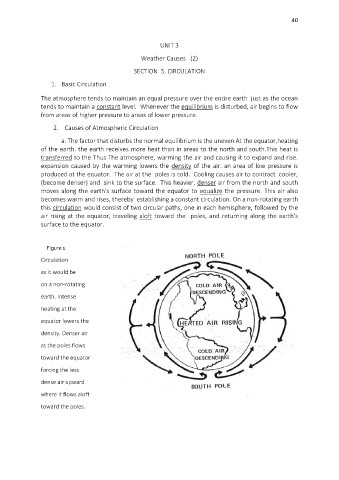
                       a. The factor that disturbs the normal equilibrium is the uneven At the equator,heating
               of the earth. the earth receives more heat than in areas to the north and south.This heat is
               transferred to the Thus The atmosphere, warming the air and causing it to expand and rise.
               expansion caused by the warming lowers the density of the air. an area of low pressure is
               produced at the equator.  The air at the  poles is cold.  Cooling causes air to contract  cooler,
               (become denser) and  sink to the surface.  This heavier, denser air from the north and south
               moves along the earth's surface toward the equator to equalize the pressure. This air also
               becomes warm and rises, thereby  establishing a constant circulation. On a non-rotating earth
               this circulation would consist of two circular paths, one in each hemisphere, followed by the
               air rising at the equator, traveling aloft toward the  poles, and returning along the earth's
               surface to the equator.


                    Figure 1
               Circulation

               as it would be

               on a non-rotating
               earth. Intense

               heating at the

               equator lowers the
               density. Denser air

               at the poles flows

               toward the equator
               forcing the less

               dense air upward

               where it flows aloft
               toward the poles.

