


Page 23 - AFMAN 15-111, 12 MAR 2019
P. 23
AFMAN15-111  12 MARCH 2019                                                                  23


                   4.11.2.  WFs/Dets should make use of existing detailed installation maps to determine marker
                   distances  while  creating/updating  visibility  reference  tools.  Additional  tools  that  may  be
                   available are military grid reference system maps, map display software/websites, laser range
                   finder equipment, global positioning system, etc. If needed, WFs/Dets can submit a work order
                   to survey the markers through the local Civil Engineering or Army equivalent agency.

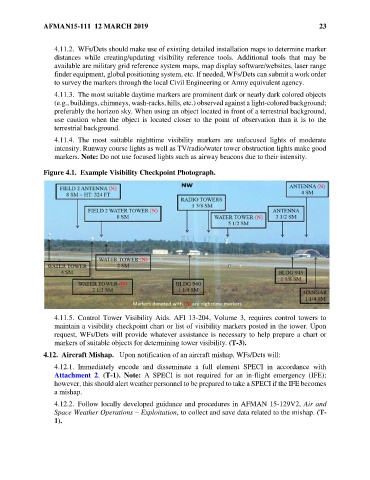
                   4.11.3.  The most suitable daytime markers are prominent dark or nearly dark colored objects
                   (e.g., buildings, chimneys, wash-racks, hills, etc.) observed against a light-colored background;
                   preferably the horizon sky. When using an object located in front of a terrestrial background,
                   use  caution  when  the  object  is  located  closer  to  the  point  of  observation  than  it  is  to  the
                   terrestrial background.
                   4.11.4.  The  most  suitable  nighttime  visibility  markers  are  unfocused  lights  of  moderate
                   intensity. Runway course lights as well as TV/radio/water tower obstruction lights make good
                   markers. Note: Do not use focused lights such as airway beacons due to their intensity.

               Figure 4.1.  Example Visibility Checkpoint Photograph.


                   4.11.5.  Control  Tower  Visibility  Aids.  AFI  13-204,  Volume  3,  requires  control  towers  to
                   maintain a visibility checkpoint chart or list of visibility markers posted in the tower. Upon
                   request, WFs/Dets will provide whatever assistance is necessary to help prepare a chart or
                   markers of suitable objects for determining tower visibility. (T-3).
               4.12.  Aircraft Mishap.   Upon notification of an aircraft mishap, WFs/Dets will:

                   4.12.1.  Immediately  encode  and  disseminate  a  full  element  SPECI  in  accordance  with
                   Attachment  2.  (T-1).  Note:  A  SPECI  is  not  required  for  an  in-flight  emergency  (IFE);
                   however, this should alert weather personnel to be prepared to take a SPECI if the IFE becomes
                   a mishap.
                   4.12.2.  Follow locally developed guidance and procedures in AFMAN 15-129V2, Air and
                   Space Weather Operations – Exploitation, to collect and save data related to the mishap. (T-
                   1).

