


Page 104 - ภาษาอังกฤษสำหรับสายวิทยาการอุตุนิยมวิทยา
P. 104
99


                                                   SECTION 2. ICING

               l. General

               a. Aircraft icing affects an aircraft's flight characteristics. When icing is severe, it can cause an
               aircraft to be unable to continue flying. Ice that forms on the outside surfaces of an aircraft
               increases the weight of the aircraft and changes the shape of surfaces on which it forms.
               Icing can also occur in the engine equipment that leads outside atmospheric air to the
               engine. Icing inside these parts reduces the flow of air to the engine. The amount of air
               entering the engine can be so reduced that the engine can no longer produce the required
               power or it stops completely. Icing is so dangerous to aircraft that many aircraft have
               equipment to prevent: the formation of ice.


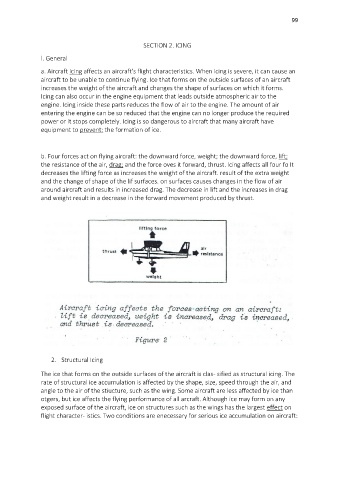
               b. Four forces act on flying aircraft: the downward force, weight; the downward force, lift;
               the resistance of the air, drag; and the force oves it forward, thrust. Icing affects all four fo It
               decreases the lifting force as increases the weight of the aircraft. result of the extra weight
               and the change of shape of the lif surfaces. on surfaces causes changes in the flow of air
               around aircraft and results in increased drag. The decrease in lift and the increases in drag
               and weight result in a decrease in the forward movement produced by thrust.


                   2.  Structural Icing

               The ice that forms on the outside surfaces of the aircraft is clas- sified as structural icing. The
               rate of structural ice accumulation is affected by the shape, size, speed through the air, and
               angle to the air of the stiucture, such as the wing. Some aircraft are less affected by ice than
               otgers, but ice affects the flying performance of all arcraft. Although ice may form on any
               exposed surface of the aircraft, ice on structures such as the wings has the largest effect on
               flight character- istics. Two conditions are enecessary for serious ice accumulation on aircraft:

