


Page 81 - ภาษาอังกฤษสำหรับสายวิทยาการอุตุนิยมวิทยา
P. 81
76


                                                         UNIT 5

                                                   Weather Causes (4)

                                                   SECTION 8. FRONTS

               1.  General

                     a. When two different air masses meet, they normally do not mix (unless their

               temperatures,  pressures, and relative humidities are very similar). Instead, a boundary is
               created called a frontal  zone, or "front." When warm air moves forward, the colder air mass

               projects under the warmer air  mass in the form of a wedge. If the boundary is not moving,

               the condition is called a "'stationary front."

                      b.Usually, the boundary moves along the earth's surface. one air mass moves back from a

               given area, it is replaced by the other air mass moving forward. This action creates a moving
               front. If warmer air is replacing the colder air, the front is called warm, or a warm front If

               colder air is  replacing the warmer air, the front is called cold, or cold front. Since fronts

               normally lie between two areas of differing pressures, wind shifts occur in both types, but the

               degree of difference is usually greater in a cold front.

               2. Warm Fronts

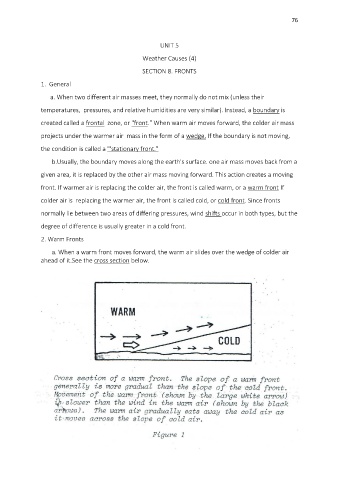
                      a. When a warm front moves forward, the warm air slides over the wedge of colder air
               ahead of it.See the cross section below.

