


Page 86 - ภาษาอังกฤษสำหรับสายวิทยาการอุตุนิยมวิทยา
P. 86
81


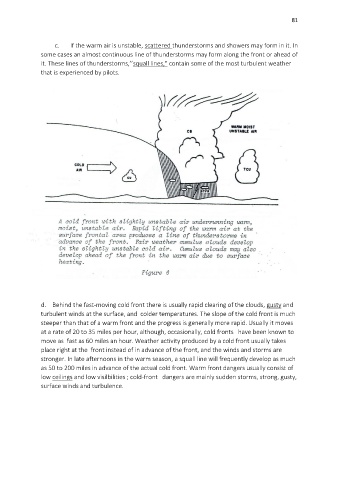
                        c.       If the warm air is unstable, scattered thunderstorms and showers may form in it. In
               some cases an almost continuous line of thunderstorms may form along the front or ahead of
               it. These lines of thunderstorms,’’squall lines," contain some of the most turbulent weather
               that is experienced by pilots.


               d.    Behind the fast-moving cold front there is usually rapid clearing of the clouds, gusty and
               turbulent winds at the surface, and  colder temperatures. The slope of the cold front is much
               steeper than that of a warm front and the progress is generally more rapid. Usually it moves
               at a rate of 20 to 35 miles per hour, although, occasionally, cold fronts   have been known to
               move as  fast as 60 miles an hour. Weather activity produced by a cold front usually takes
               place right at the  front instead of in advance of the front, and the winds and storms are
               stronger. In late afternoons in the warm season, a squall line will frequently develop as much
               as 50 to 200 miles in advance of the actual cold front. Warm front dangers usually consist of
               low ceilings and low visilbilities ; cold-front   dangers are mainly sudden storms, strong, gusty,
               surface winds and turbulence.

