


Page 43 - AFMAN 15-111, 12 MAR 2019
P. 43
AFMAN15-111  12 MARCH 2019                                                                  43


                                                         Chapter 9

                                            RUNWAY VISUAL RANGE (RVR)


               9.1.  Introduction.   This chapter describes the observing and reporting standards for RVR data.
               RVR is an instrumentally derived value that represents the horizontal distance that a pilot can see
               down the runway. The  maximum distance in  the direction of takeoff or landing at  which the
               runway, or specified lights or markers delineating it, can be seen from a position above a specified
               point on its center. For all locations reporting RVR, the unit of measure will correspond to the
               units of measure used to report visibility (i.e. feet for SM and m for meters). (T-2).

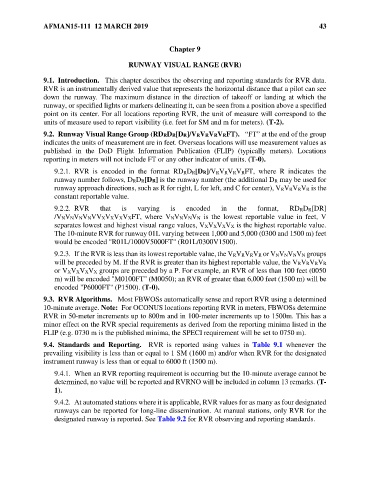
               9.2.  Runway Visual Range Group (RDRDR[DR]/VRVRVRVRFT).   “FT” at the end of the group
               indicates the units of measurement are in feet. Overseas locations will use measurement values as
               published  in  the  DoD  Flight  Information  Publication  (FLIP)  (typically  meters).  Locations
               reporting in meters will not include FT or any other indicator of units. (T-0).
                   9.2.1.  RVR  is  encoded  in  the  format  RDRDR[DR]/VRVRVRVRFT,  where  R  indicates  the
                   runway number follows, DRDR[DR] is the runway number (the additional DR may be used for
                   runway approach directions, such as R for right, L for left, and C for center), VRVRVRVR is the
                   constant reportable value.
                   9.2.2.  RVR    that   is    varying   is    encoded    in    the   format,    RDRDR[DR]
                   /VNVNVNVNVVXVXVXVXFT,  where  VNVNVNVN  is  the  lowest  reportable  value  in  feet,  V
                   separates lowest and highest visual range values, VXVXVXVX is the highest reportable value.
                   The 10-minute RVR for runway 01L varying between 1,000 and 5,000 (0300 and 1500 m) feet
                   would be encoded "R01L/1000V5000FT" (R01L/0300V1500).

                   9.2.3.  If the RVR is less than its lowest reportable value, the VRVRVRVR or VNVNVNVN groups
                   will be preceded by M. If the RVR is greater than its highest reportable value, the VRVRVRVR
                   or VXVXVXVX groups are preceded by a P. For example, an RVR of less than 100 feet (0050
                   m) will be encoded "M0100FT" (M0050); an RVR of greater than 6,000 feet (1500 m) will be
                   encoded "P6000FT" (P1500). (T-0).

               9.3.  RVR Algorithms.   Most FBWOSs automatically sense and report RVR using a determined
               10-minute average. Note:  For OCONUS locations reporting RVR in meters, FBWOSs determine
               RVR in 50-meter increments up to 800m and in 100-meter increments up to 1500m. This has a
               minor effect on the RVR special requirements as derived from the reporting minima listed in the
               FLIP (e.g. 0730 m is the published minima, the SPECI requirement will be set to 0750 m).
               9.4.  Standards  and  Reporting.    RVR  is  reported  using  values  in  Table  9.1  whenever  the
               prevailing visibility is less than or equal to 1 SM (1600 m) and/or when RVR for the designated
               instrument runway is less than or equal to 6000 ft (1500 m).
                   9.4.1.  When an RVR reporting requirement is occurring but the 10-minute average cannot be
                   determined, no value will be reported and RVRNO will be included in column 13 remarks. (T-
                   1).
                   9.4.2.  At automated stations where it is applicable, RVR values for as many as four designated
                   runways can be reported for long-line dissemination. At manual stations, only RVR for the
                   designated runway is reported. See Table 9.2 for RVR observing and reporting standards.

