


Page 38 - AFMAN 15-111, 12 MAR 2019
P. 38
38                                                         AFMAN15-111  12 MARCH 2019


               7.5.  Manual Observing Methods.

                   7.5.1.  Predominant wind direction, speed, gusts, and shifts are determined by the primary
                   active  wind  sensor;  peak  wind  data  is  determined  by  all  available  runway  sensors.  Data
                   obtained from alternate equipment may be used as a guide for determining winds when the
                   primary sensor is considered unrepresentative or inoperative. Note: Winds will be reported as
                   estimated when obtained from any source other than the properly sited wind sensor for the
                   active runway (T-2). See Attachment 3 for remark format.

                   7.5.2.  To determine wind direction manually using a compass (or digital measuring device),
                   face into the wind in an unobstructed area and take a 2-minute average reading of the wind
                   direction;  convert  this  magnetic  direction  to  true  direction  where  applicable.  While
                   determining the predominant direction, take note of the limits of variability for reporting when
                   applicable. Note:  Do not use the movement of clouds, regardless of how low they are, in
                   determining the surface wind direction.
                   7.5.3.  To determine wind speed manually, using an approved anemometer face into the wind
                   in an unobstructed area with the device held at eye-level and take a 2-minute average reading
                   of the wind speed. Use the same method over a 10-minute period to determine gusts when
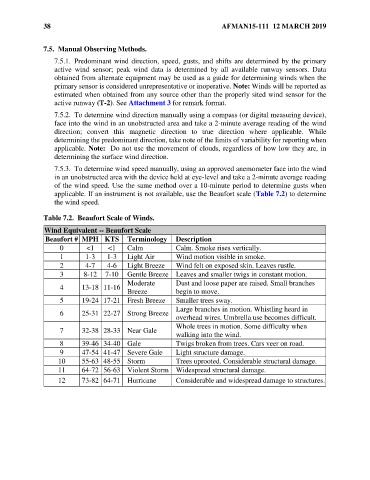
                   applicable. If an instrument is not available, use the Beaufort scale (Table 7.2) to determine
                   the wind speed.

               Table 7.2.  Beaufort Scale of Winds.

                Wind Equivalent -- Beaufort Scale
                Beaufort #  MPH  KTS  Terminology  Description
                     0        <1     <1    Calm            Calm. Smoke rises vertically.
                     1       1-3    1-3    Light Air       Wind motion visible in smoke.
                     2       4-7    4-6    Light Breeze    Wind felt on exposed skin. Leaves rustle.
                     3       8-12  7-10  Gentle Breeze  Leaves and smaller twigs in constant motion.
                                           Moderate        Dust and loose paper are raised. Small branches
                     4      13-18  11-16
                                           Breeze          begin to move.
                     5      19-24  17-21  Fresh Breeze     Smaller trees sway.
                                                           Large branches in motion. Whistling heard in
                     6      25-31  22-27  Strong Breeze
                                                           overhead wires. Umbrella use becomes difficult.
                                                           Whole trees in motion. Some difficulty when
                     7      32-38  28-33  Near Gale
                                                           walking into the wind.
                     8      39-46  34-40  Gale             Twigs broken from trees. Cars veer on road.
                     9      47-54  41-47  Severe Gale      Light structure damage.
                    10      55-63  48-55  Storm            Trees uprooted. Considerable structural damage.
                    11      64-72  56-63  Violent Storm  Widespread structural damage.
                    12      73-82  64-71  Hurricane        Considerable and widespread damage to structures.

