


Page 40 - AFMAN 15-111, 12 MAR 2019
P. 40
40                                                         AFMAN15-111  12 MARCH 2019


                   8.4.6.  Software  limitations  in  some  automated  sensors  only  support  visibility  reporting
                   increments of 1/4SM (from 0 to 1 3/4 SM) and 1/2 SM (from 2 to 3 SM). Leadership will
                   locally document procedures to ensure supplementation during controlled airfield hours for
                   observed values that are beyond the capability of the software to report when required to meet
                   published landing and/or circling minimum visibility values. (T-3).

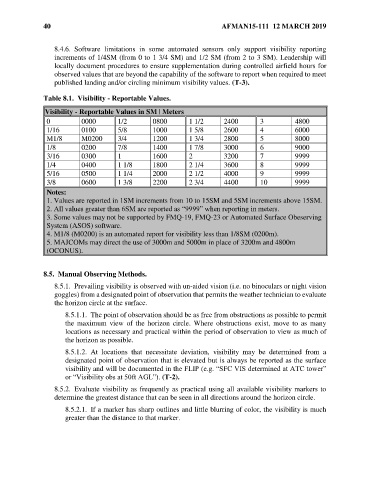
               Table 8.1.  Visibility - Reportable Values.

                Visibility - Reportable Values in SM | Meters
                0           0000        1/2         0800        1 1/2      2400        3           4800
                1/16        0100        5/8         1000        1 5/8      2600        4           6000
                M1/8        M0200       3/4         1200        1 3/4      2800        5           8000
                1/8         0200        7/8         1400        1 7/8      3000        6           9000
                3/16        0300        1           1600        2          3200        7           9999
                1/4         0400        1 1/8       1800        2 1/4      3600        8           9999
                5/16        0500        1 1/4       2000        2 1/2      4000        9           9999
                3/8         0600        1 3/8       2200        2 3/4      4400        10          9999
                Notes:
                1. Values are reported in 1SM increments from 10 to 15SM and 5SM increments above 15SM.
                2. All values greater than 6SM are reported as “9999” when reporting in meters.
                3. Some values may not be supported by FMQ-19, FMQ-23 or Automated Surface Obeserving
                System (ASOS) software.
                4. M1/8 (M0200) is an automated report for visibility less than 1/8SM (0200m).
                5. MAJCOMs may direct the use of 3000m and 5000m in place of 3200m and 4800m
                (OCONUS).


               8.5.  Manual Observing Methods.
                   8.5.1.  Prevailing visibility is observed with un-aided vision (i.e. no binoculars or night vision
                   goggles) from a designated point of observation that permits the weather technician to evaluate
                   the horizon circle at the surface.
                       8.5.1.1.  The point of observation should be as free from obstructions as possible to permit
                       the  maximum  view  of  the  horizon  circle.  Where  obstructions  exist,  move  to  as  many
                       locations as necessary and practical within the period of observation to view as much of
                       the horizon as possible.

                       8.5.1.2.  At  locations  that  necessitate  deviation,  visibility  may  be  determined  from  a
                       designated point of observation that is elevated but is always be reported as the surface
                       visibility and will be documented in the FLIP (e.g. “SFC VIS determined at ATC tower”
                       or “Visibility obs at 50ft AGL”). (T-2).
                   8.5.2.  Evaluate visibility as frequently as practical using all available visibility markers to
                   determine the greatest distance that can be seen in all directions around the horizon circle.

                       8.5.2.1.  If a marker has sharp outlines and little blurring of color, the visibility is much
                       greater than the distance to that marker.

