


Page 32 - AFMAN 15-111, 12 MAR 2019
P. 32
32                                                         AFMAN15-111  12 MARCH 2019


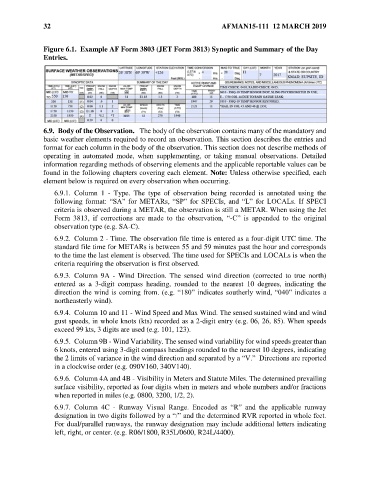
               Figure 6.1.  Example AF Form 3803 (JET Form 3813) Synoptic and Summary of the Day
               Entries.


               6.9.  Body of the Observation.   The body of the observation contains many of the mandatory and
               basic weather elements required to record an observation. This section describes the entries and
               format for each column in the body of the observation. This section does not describe methods of
               operating  in  automated  mode,  when  supplementing,  or  taking  manual  observations.  Detailed
               information regarding methods of observing elements and the applicable reportable values can be
               found in the following chapters covering each element. Note: Unless otherwise specified, each
               element below is required on every observation when occurring.

                   6.9.1.  Column  1  -  Type.  The  type  of  observation  being  recorded  is  annotated  using  the
                   following format: “SA”  for METARs,  “SP” for  SPECIs,  and “L”  for  LOCALs.  If SPECI
                   criteria is observed during a METAR, the observation is still a METAR. When using the Jet
                   Form  3813,  if  corrections  are  made  to  the  observation,  “-C”  is  appended  to  the  original
                   observation type (e.g. SA-C).
                   6.9.2.  Column 2 - Time. The observation file time is entered as a four-digit UTC time. The
                   standard file time for METARs is between 55 and 59 minutes past the hour and corresponds
                   to the time the last element is observed. The time used for SPECIs and LOCALs is when the
                   criteria requiring the observation is first observed.
                   6.9.3.  Column  9A  -  Wind  Direction.  The  sensed  wind  direction  (corrected  to  true  north)
                   entered  as  a  3-digit  compass  heading,  rounded  to  the  nearest  10  degrees,  indicating  the
                   direction the wind is coming from. (e.g. “180” indicates southerly wind, “040” indicates a
                   northeasterly wind).

                   6.9.4.  Column 10 and 11 - Wind Speed and Max Wind. The sensed sustained wind and wind
                   gust speeds, in whole knots (kts) recorded as a 2-digit entry (e.g. 06, 26, 85). When speeds
                   exceed 99 kts, 3 digits are used (e.g. 101, 123).

                   6.9.5.  Column 9B - Wind Variability. The sensed wind variability for wind speeds greater than
                   6 knots, entered using 3-digit compass headings rounded to the nearest 10 degrees, indicating
                   the 2 limits of variance in the wind direction and separated by a “V.”  Directions are reported
                   in a clockwise order (e.g. 090V160, 340V140).
                   6.9.6.  Column 4A and 4B - Visibility in Meters and Statute Miles. The determined prevailing
                   surface visibility, reported as four digits when in meters and whole numbers and/or fractions
                   when reported in miles (e.g. 0800, 3200, 1/2, 2).
                   6.9.7.  Column  4C  -  Runway  Visual  Range.  Encoded  as  “R”  and  the  applicable  runway
                   designation in two digits followed by a “/” and the determined RVR reported in whole feet.
                   For dual/parallel runways, the runway designation may include additional letters indicating
                   left, right, or center. (e.g. R06/1800, R35L/0600, R24L/4400).

