


Page 128 - ภาษาอังกฤษสำหรับสายวิทยาการอุตุนิยมวิทยา
P. 128
123


                    7.   High-Level Mechanical Turbulence

                       a. The air flow becomes very disturbed when wind blows over long lines of mountains.
               The wind blowing up the slope is usually relatively smooth if the air is stable. On the downwind
               side the air falls rapidly down the slope. This produces strong downdrafts and causes the air
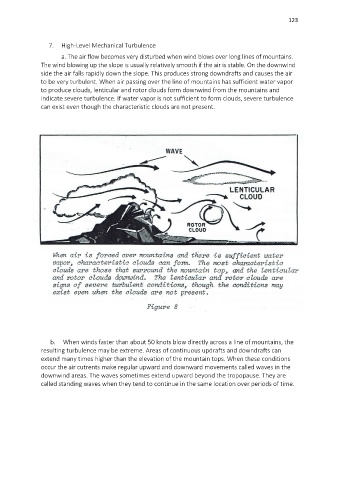
               to be very turbulent. When air passing over the line of mountains has sufficient water vapor
               to produce clouds, lenticular and rotor clouds form downwind from the mountains and
               indicate severe turbulence. If water vapor is not sufficient to form clouds, severe turbulence
               can exist even though the characteristic clouds are not present.


                     b.    When winds faster than about 50 knots blow directly across a line of mountains, the
               resulting turbulence may be extreme. Areas of continuous updrafts and downdrafts can
               extend many times higher than the elevation of the mountain tops. When these conditions
               occur the air cutrents make regular upward and downward movements called waves in the
               downwind areas. The waves sometimes extend upward beyond the tropopause. They are
               called standing waves when they tend to continue in the same location over periods of time.

