


Page 58 - AFMAN 15-111, 12 MAR 2019
P. 58
58 AFMAN15-111 12 MARCH 2019
Chapter 11
SKY CONDITION
11.1. Introduction. This chapter describes the observing and reporting standards for sky
condition. Sky condition is a description of the celestial dome as seen from a single point on the
surface of the earth and is reported with relation to what could be seen if there was an unobstructed
view from horizon to horizon.
11.2. Sky Condition Group (NsNsNshshshs or VVhshshs or SKC or CLR). Sky condition is
encoded in the format, NsNsNshshshs, where NsNsNs is the amount of sky cover and hshshs is the
height of the base of the layer in hundreds of feet above the surface. There is no space between the
amount of sky cover and the height of the layer. Report layer height using reportable values in
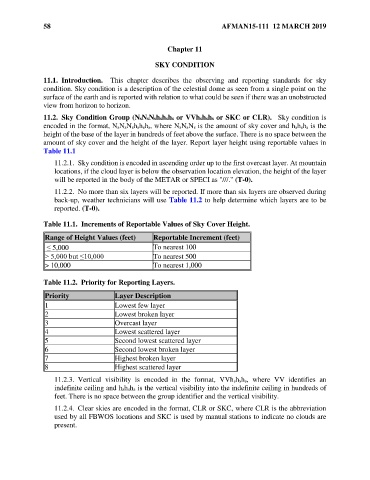
Table 11.1
11.2.1. Sky condition is encoded in ascending order up to the first overcast layer. At mountain
locations, if the cloud layer is below the observation location elevation, the height of the layer
will be reported in the body of the METAR or SPECI as "///." (T-0).
11.2.2. No more than six layers will be reported. If more than six layers are observed during
back-up, weather technicians will use Table 11.2 to help determine which layers are to be
reported. (T-0).
Table 11.1. Increments of Reportable Values of Sky Cover Height.
Range of Height Values (feet) Reportable Increment (feet)
≤5,000 To nearest 100
> 5,000 but ≤10,000 To nearest 500
> 10,000 To nearest 1,000
Table 11.2. Priority for Reporting Layers.
Priority Layer Description
1 Lowest few layer
2 Lowest broken layer
3 Overcast layer
4 Lowest scattered layer
5 Second lowest scattered layer
6 Second lowest broken layer
7 Highest broken layer
8 Highest scattered layer
11.2.3. Vertical visibility is encoded in the format, VVhshshs, where VV identifies an
indefinite ceiling and hshshs is the vertical visibility into the indefinite ceiling in hundreds of
feet. There is no space between the group identifier and the vertical visibility.
11.2.4. Clear skies are encoded in the format, CLR or SKC, where CLR is the abbreviation
used by all FBWOS locations and SKC is used by manual stations to indicate no clouds are
present.

