


Page 60 - AFMAN 15-111, 12 MAR 2019
P. 60
60 AFMAN15-111 12 MARCH 2019
11.4.4. Sky cover code forms reflect the degree of sky coverage based on a summation of the
amount of clouds/obscuring phenomena at and below layer being evaluated. The approved
code forms are listed below (with encoded form in parenthesis):
11.4.4.1. Sky Clear (SKC or CLR) - The absence of any clouds/obscuring phenomena;
0/8ths coverage. Note: Sometimes encoded as NCD or NSC by automated stations and
organizations outside of AF weather to indicate No (Significant) Clouds Detected below
12,000ft (or 25,000ft with the 25K algorithm); CLR, NCD and NSC do not necessarily
indicate clear skies.
11.4.4.2. Few (FEW) - A trace through 2/8ths coverage.
11.4.4.3. Scattered (SCT) - 3/8ths through 4/8ths coverage.
11.4.4.4. Broken (BKN) - 5/8ths through less than 8/8ths. Note: The lowest BKN or
greater layer represents the ceiling.
11.4.4.5. Overcast (OVC) - The sky is completely covered by clouds/obscuring
phenomena; 8/8ths coverage. Note: All layers are treated as opaque (i.e. an overcast layer
of thin cirrus can be seen through however the sky is still overcast).
11.4.4.6. Vertical Visibility (VV) - The sky is completely covered by a surface-based
phenomena (e.g. snow, fog); 8/8ths coverage. The terms totally obscured and indefinite
ceiling may also be used in relation to this sky condition. Note: Vertical Visibility
constitutes a ceiling.
11.4.5. For aviation purposes, the reported ceiling is defined as the lowest height at which the
summation of layers equals broken or greater coverage (> 5/8ths) or the maximum height that
can be observed into a vertical visibly obscuration.
11.4.6. A variable ceiling represents a situation in which the height of the ceiling rapidly
increases and decreases by specified amounts during the period of observation and the ceiling
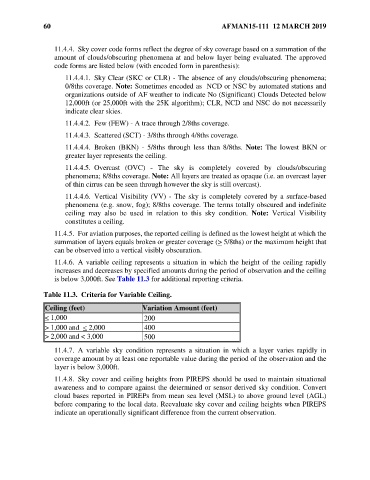
is below 3,000ft. See Table 11.3 for additional reporting criteria.
Table 11.3. Criteria for Variable Ceiling.
Ceiling (feet) Variation Amount (feet)
< 1,000 200
> 1,000 and 2,000 400
> 2,000 and < 3,000 500
11.4.7. A variable sky condition represents a situation in which a layer varies rapidly in
coverage amount by at least one reportable value during the period of the observation and the
layer is below 3,000ft.
11.4.8. Sky cover and ceiling heights from PIREPS should be used to maintain situational
awareness and to compare against the determined or sensor derived sky condition. Convert
cloud bases reported in PIREPs from mean sea level (MSL) to above ground level (AGL)
before comparing to the local data. Reevaluate sky cover and ceiling heights when PIREPS
indicate an operationally significant difference from the current observation.

